
JUSTIN KRUGER / ASTRO ATOMICA / ENGINEERING CASE STUDY
One field guide.
Two ways to explore it.
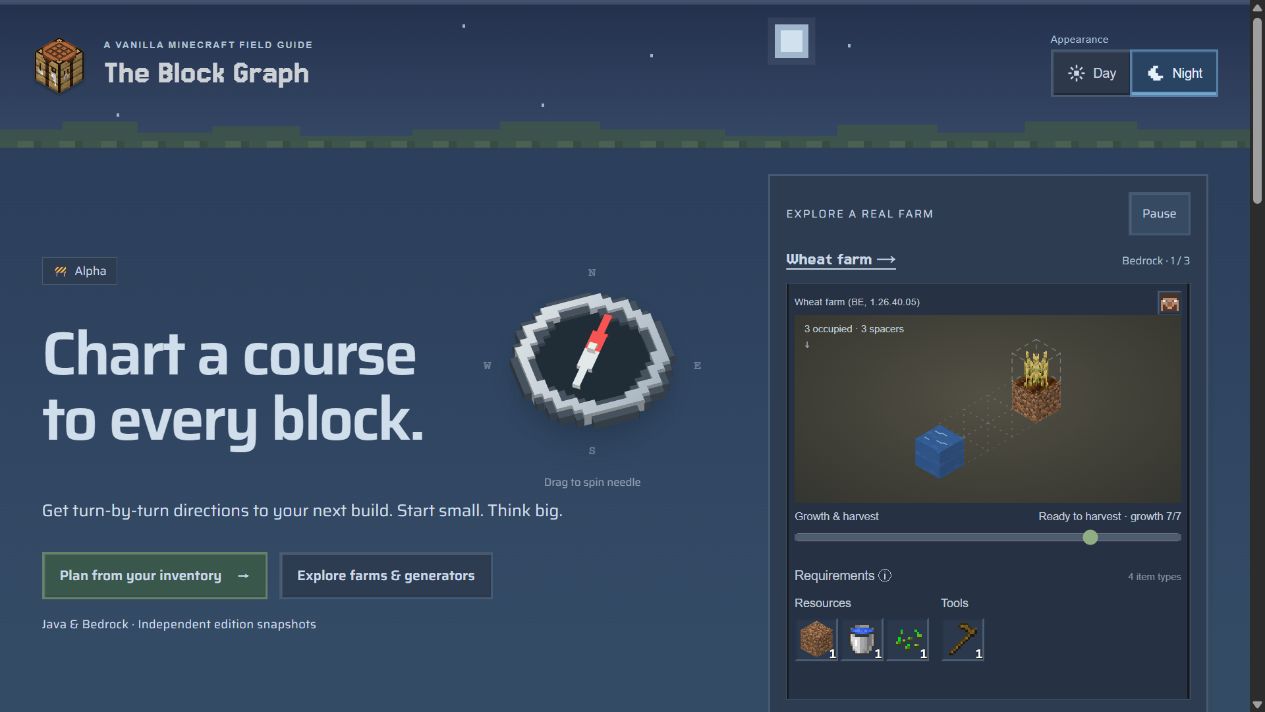
The Block Graph brings resource relationships, recipes, and illustrated farms into a browser. People explore through the interface; agents query versioned, read-only tools.
- Product
- Public alpha
- Data model
- Java + Bedrock snapshots
- Agent interface
- 9 read-only tools
- Reviewed release
- Build 67 · October 19, 2026
THE PROBLEM
A list of ingredients is only part of the answer.
A useful resource plan also needs quantities, prerequisites, edition-specific rules, and a clear account of what is still unknown. Combining those into a single answer risks hiding the conditions that make it valid.
The design keeps the selected edition and source evidence attached to the answer, whether it appears in a human-facing view or an agent response.
THREE ENGINEERING DECISIONS
Make the answer inspectable.
Keep edition boundaries explicit.
Java and Bedrock use independent dataset snapshots. Agent requests name an edition; responses carry dataset provenance and build identity. A result can be traced to the data that produced it.
Tradeoff: Separate versions and conditions require more maintenance. They avoid presenting a convenient universal answer where the underlying rules differ.
Inspect the published data manifest ↗Give agents a contract they can check.
Nine read-only WebMCP tools expose resource search, recipes, farms, and planning. The interface publishes semantic versions, input schemas, migration notes, capability limits, and release metadata. Compatibility checks happen before content work.
Tradeoff: Every interface change creates a compatibility obligation. Browser support is conditional; the ordinary website remains usable without WebMCP.
Read the public API reference ↗Bound the search. Preserve the uncertainty.
Recipe planning runs in a cancellable worker. Results distinguish a complete plan, missing inputs, and a search limit. Reaching a limit does not become a claim that a resource is impossible to obtain.
Tradeoff: A bounded planner may leave a question unresolved. Returning that limitation is more useful than silently treating an incomplete search as proof.
Explore the planning interface ↗EVIDENCE & LIMITS
A shipped interface, with boundaries you can inspect.
On October 21, 2026, the public release record reported Build 67 and the API manifest reported version 2.16.0. A live browser discovery call returned matching metadata. These are release and interface checks, not measurements of adoption, user success, or reliability over time.
- Public release identity ↗
- Machine-readable API contract ↗
- Version history and migration notes ↗
- Coverage and known gaps ↗
The next evaluation is whether people can reach a useful plan more reliably and with less effort. That needs observed tasks, representative performance measurements, and feedback from users beyond the project team.
TALK THROUGH THE WORK
Interested in the decisions behind the interface?
Get in touch with Justin at Astro Atomica to discuss product engineering, API design, and building tools for people and agents.
Contact Astro Atomica